
Speed
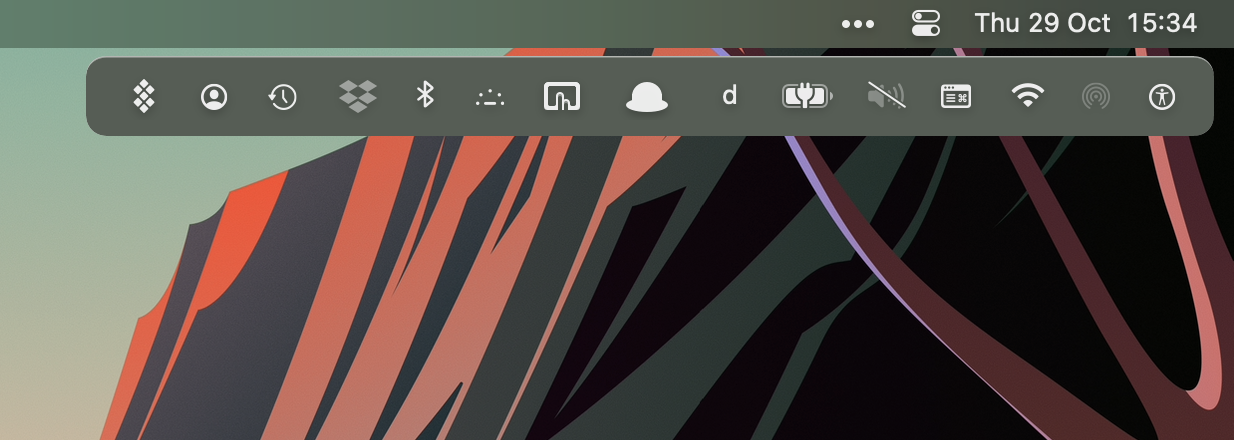
Lightning-fast access to your menu bar items is now even better. Get instant access to your hidden menu bar items simply by swiping or scrolling in the menu bar, clicking on the menu bar, or if you prefer, simply hovering.
Bartender is an award-winning app for macOS that for more than 10 years has superpowered your menu bar, giving you total control over your menu bar items, what's displayed, and when, with menu bar items only showing when you need them.
Bartender improves your workflow with quick reveal, search, custom hotkeys and triggers, and lots more.
Lightning-fast access to your menu bar items is now even better. Get instant access to your hidden menu bar items simply by swiping or scrolling in the menu bar, clicking on the menu bar, or if you prefer, simply hovering.

Access the menu bar items otherwise hidden by the notch on MacBook Air and Pro screens. Bartender will automatically hide your currently shown menu bar items when needed to create room to show the items hidden by the MacBook Air and Pro screens notch, giving you access to all your menu bar items.
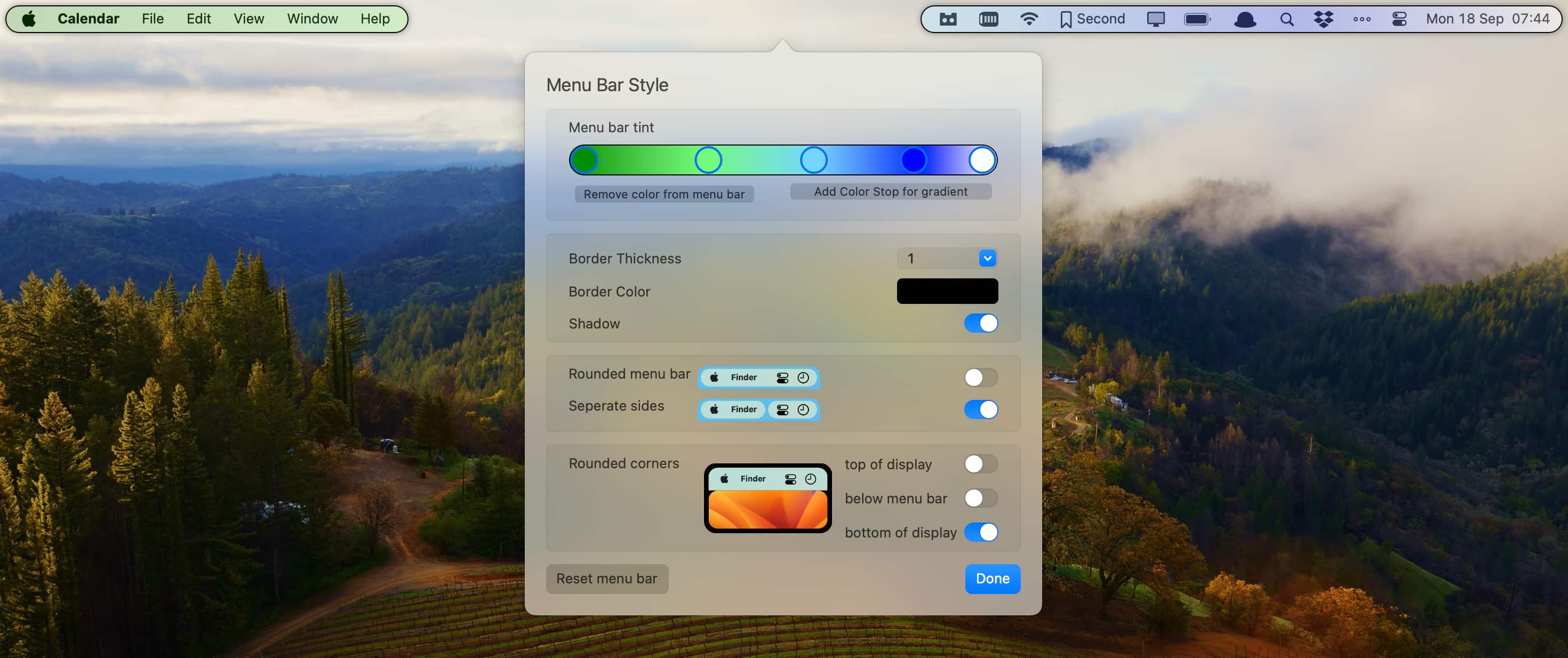

Make your menu bar your own, with menu bar styling you can:

Combine multiple menu bar items into one customisable menu bar item, and have quick access to all the menu bar items within.
For example group all your cloud drive apps together like Dropbox, OneDrive, Google Drive.
Have a group for connection related items such as Wi-Fi and VPN.
And another for media related items, like volume, media controls, airplay.
This can be a great way to have access to all your menu bar items on a MacBook Pro or Air with limited menu bar space due to the screen notch.
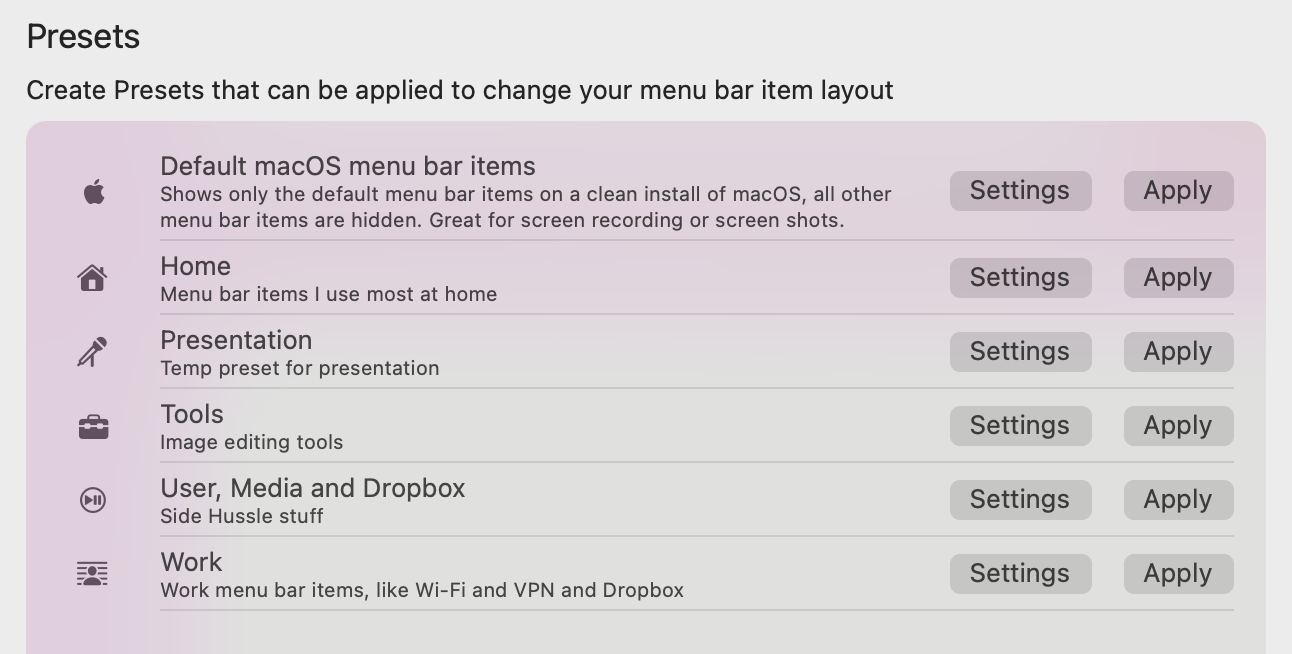
Create as many presets as you want and always have the right menu bar items available for your current workflow.
Show the macOS default menu bar items when recording your screen or screen sharing
Show work specific menu bar items in work hours, then social media items when at home... the possibilities are endless.
Presets can be automatically applied via triggers and also by macOS Focus modes.
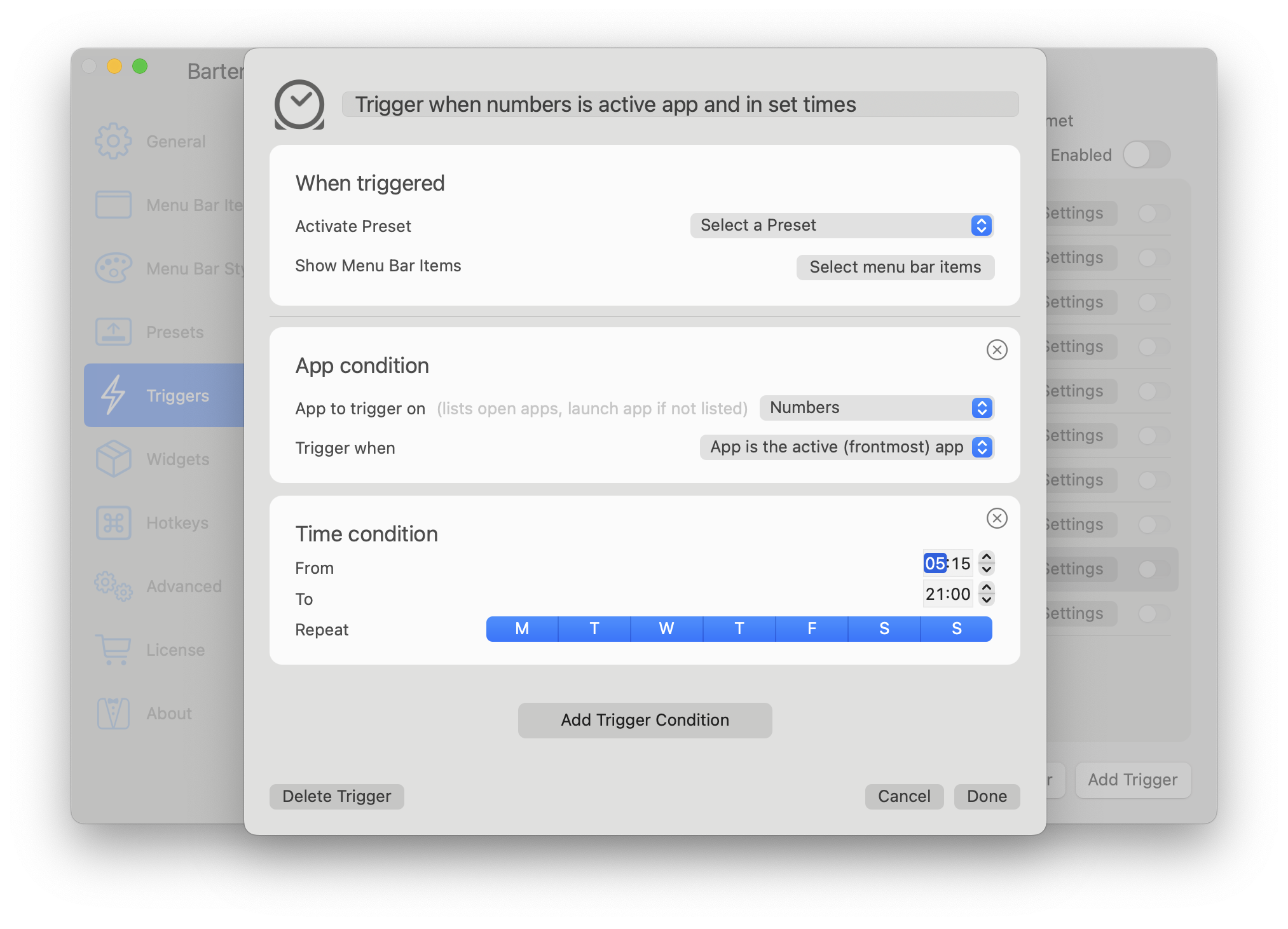
With a completely new Trigger system
you can apply a preset automatically, or show a set of menu bar items whenever your trigger conditions are met. Triggers conditions currently include
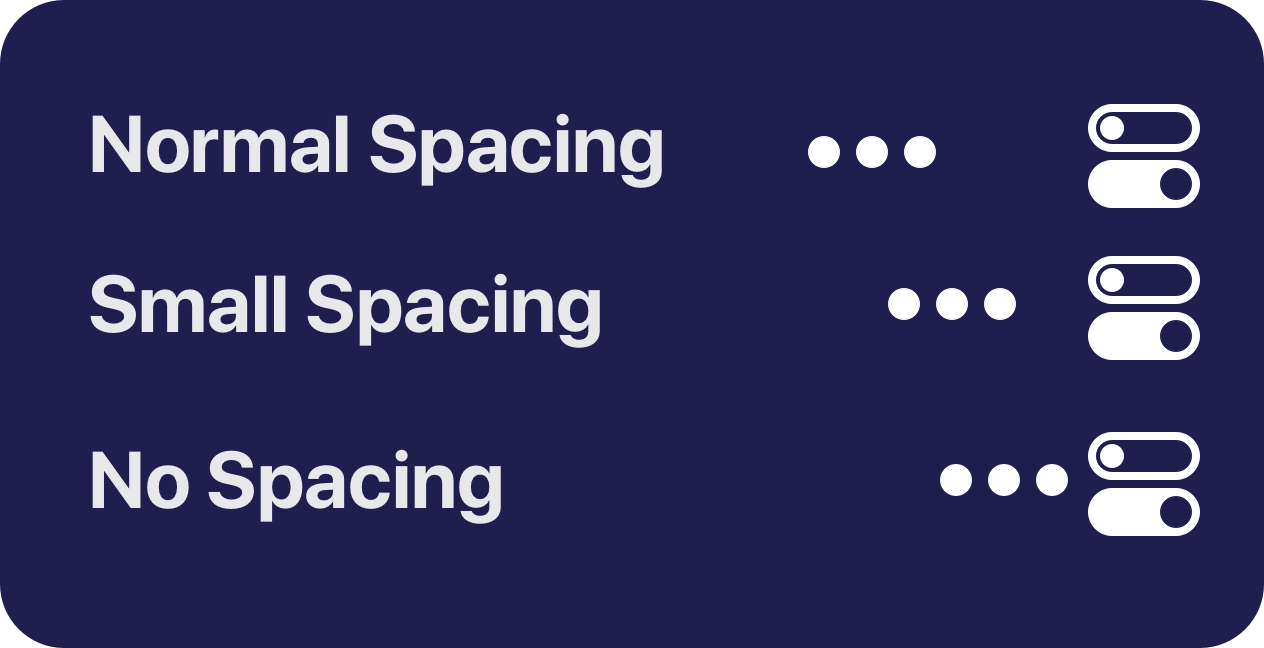
Reduce the space between menu bar items using Bartender, allowing you to have more menu items onscreen before reaching the macbook notch. Or just purely for style.
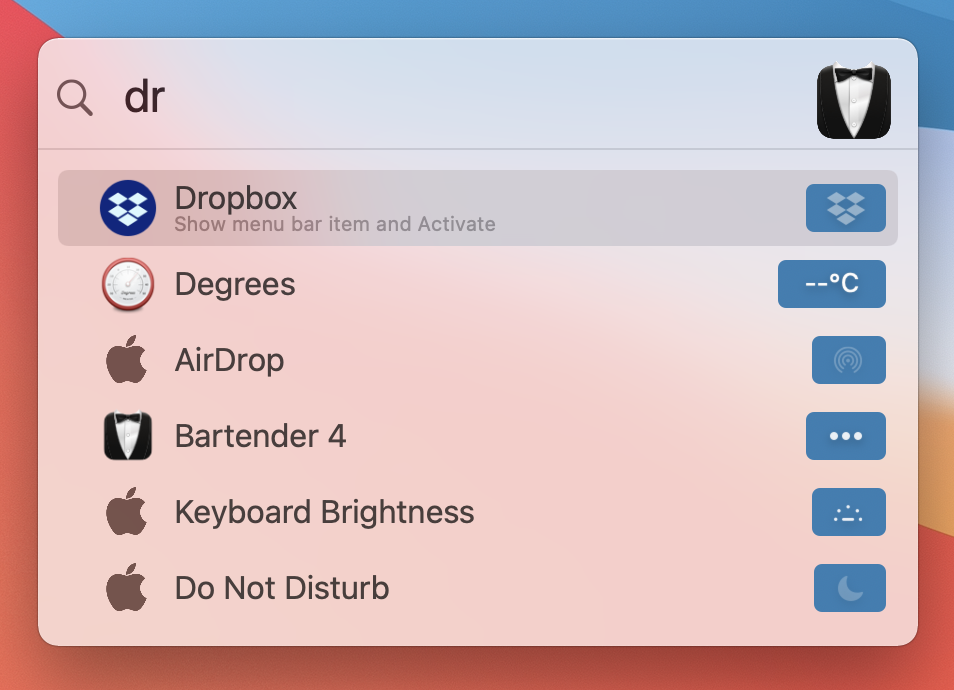
Quick Search will change the way you use your menu bar apps.
Instantly find, show, and activate menu bar items, all from your keyboard.
* the macOS screen capture menu bar item can show when using this. more info

Bartender 5 is designed for all the great changes in macOS Sonoma.
Bartender 5 runs native and lightning-fast on Apple Silicon and Intel macs.
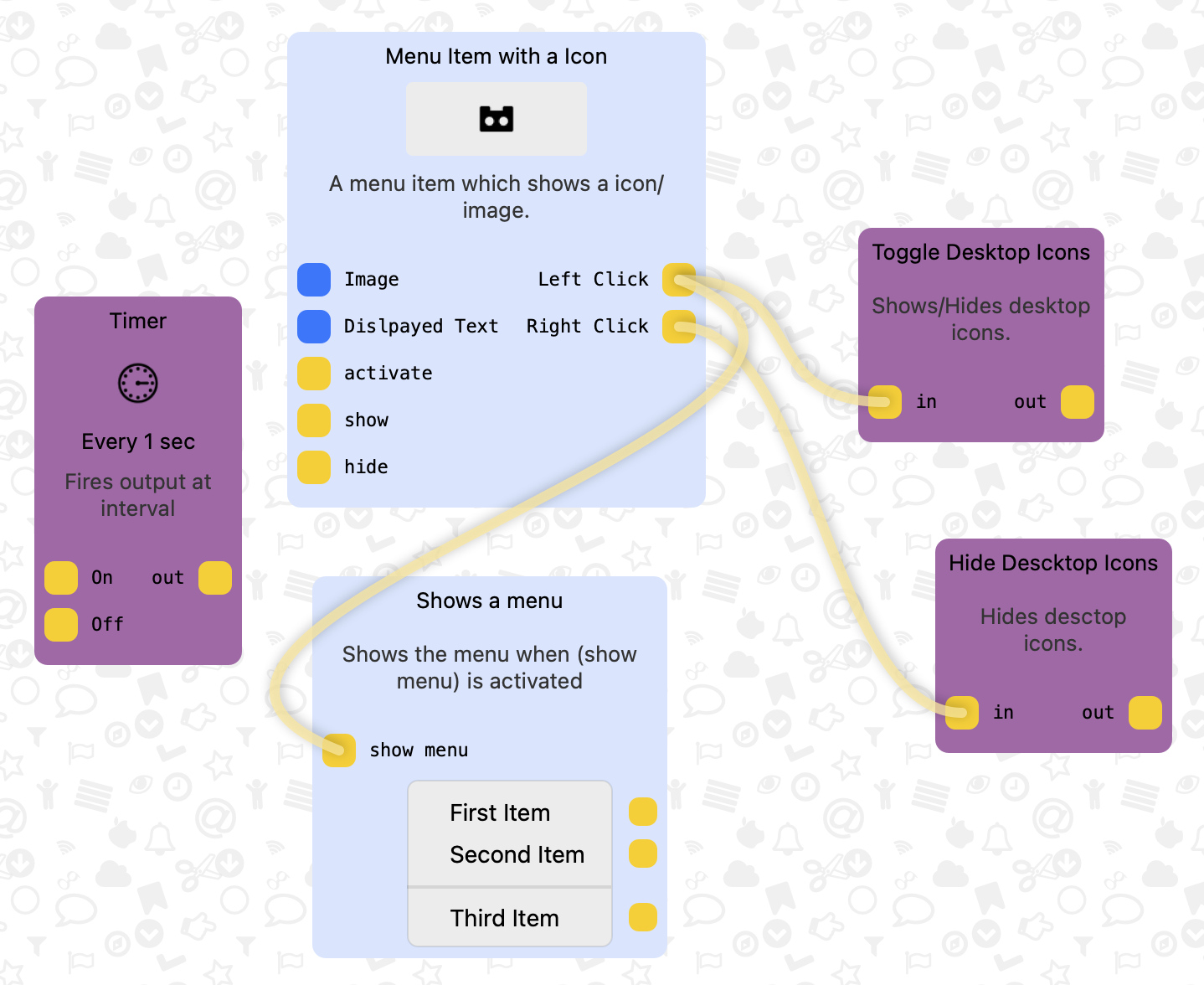
Create your own menu bar items
With Bartender widgets you can create your very own custom menu bar items, that trigger pretty much any action you want, no coding required.
Add hotkeys for any menu bar item; this can show and activate any menu bar item via any hotkey you assign.
With Spacers, your menu bar is uniquely your own, with the ability to customize menu item grouping and display labels or emojis to personalize your menu bar.
Use Apple Script to show and activate menu bar items. Fantastic for some advanced workflows.
Swap shown items for your hidden ones to take up less menu bar space, allowing you to have more menu bar items on a smaller screen.
You can choose where new menu items will appear in your menu bar, shown for instant access, or hidden for less distraction.
Om Hanumante Namah. Om Mahaveer Hanumanta. Om Kaala Tahal Hanumanta. Om Rakt Hanumanta. Om Chal-Chal Anjani-Putra Grah Chal. Haank Det Haki Koodi. Hanumant Lanka Jaari. Pavan-Putra! Anjaniyaanand-Kari Ram Doot, Hanumant! Kh-Kh-Khang.
Finally, the act of archiving itself is a cultural intervention with political ramifications. Recognizing shabar mantras as worthy of preservation contests hierarchies that privilege canonical scripture while marginalizing folk practices as superstition. Done ethically, an internet archive can affirm the value of vernacular spiritual knowledge, bolster cultural resilience, and create spaces for community-led heritage work. Done poorly, it risks appropriation, harm, and the erosion of living practices.
Based on the scanned manuscripts available, here are five classic Shabar Mantras that users hunt for. (Note: These are written phonetically as they appear in the archive scans). shabar mantra internet archive
If you want to dive deeper into this digital library, let me know:
Unlike the highly structured, Sanskrit-based Vedic mantras (which require precise pronunciation to work), are the language of the common mystic. Legend says they originated from the Nath Yogis—particularly Guru Gorakhnath—who wanted to demystify spirituality. Om Hanumante Namah
These mantras are rarely written in pure Sanskrit. Instead, they utilize old Hindi, Prakrit, Apabhramsha, rural dialects, and sometimes a mix of regional languages like Bengali, Punjabi, or Gujarati.
Legend states that Lord Shiva created these mantras to help humanity during the Kali Yuga , an age of spiritual decline, as a simpler "safety net" compared to complex Vedic practices. Om Rakt Hanumanta
The range of Shabar mantras is vast, addressing almost every conceivable human desire and challenge. They can be used for:
For academic researchers, the Internet Archive provides a text-searchable database where linguists can study the evolution of regional Indian dialects. Anthropologists can also trace how rural communities used these mantras as a form of folk medicine, psychological defense, and community protection against plagues, wild animals, and crop failures. Navigating Shabar Mantra Literature on the Archive
Because Shabar Mantras are an oral tradition, textual reading only conveys half of the practice; the cadence, rhythm, and tone are crucial. The Internet Archive hosts community audio uploads featuring field recordings of village elders, Nath yogis, and folk singers chanting these rhythms. These audio archives are invaluable for anyone trying to understand the phonetic delivery of words that do not conform to standard dictionary rules. The Ethics of Digital Esotericism
Common uses: Protection from black magic, attracting a lost lover, winning a court case, curing sudden illnesses, or financial stability.