|
||||||
|
|





|
|
|
Device Configuration Guides
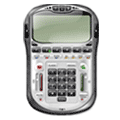
Counterpath X-Lite/eyeBeam Messaging Setup
 This configuration guide assumes that you have already followed the main setup guide and have the softphone installed and working with your voip line. STEP 1
Fateful Findings - 2013 - Neil Breen ((better)) 〈Firefox DIRECT〉Dylan is presented as an infallible genius—the "smartest in the room"—who manages to hack "the most secret government and corporate secrets" using a collection of non-functional laptops. Surrealism and Discontinuity: : Breen treats his audience to multiple scenes in which his character removes his shirt in what he apparently imagines is sexual seduction, revealing what one critic called "a hairless, bird-like chest" that Breen seems to believe will send women into fits of erotic ecstasy. The sex scenes, one critic wrote, feel "like they were ghost-written by a 10-year-old boy who has yet to be given the 'facts of life' speech". is a micro-budget independent thriller written, directed, produced, and edited by Las Vegas architect Neil Breen, who also stars as the protagonist. Unlike corporate-produced films, every frame of Fateful Findings A continued, inexplicable fixation on destroying perfectly good laptops by throwing them against walls or into water. Fateful Findings - 2013 - Neil Breen Here’s an interesting, discussion-ready post about , tailored for a film subreddit, Letterboxd, or social media: Fateful Findings premiered at the invite-only Butt-Numb-A-Thon in 2012 before making its public festival debut at the Seattle International Film Festival on May 23, 2013. It received a limited theatrical release in early 2014. The film’s production oddities have also become legendary. The psychiatrist’s office, for example, is an empty boardroom with a dozen chairs around a long table. Phones are picked up before they ring. Cameras occasionally shoot from the knees down for no apparent reason, leading some fans to joke that Breen has a foot fetish. A scene where Dylan’s blood runs down his leg in the shower extends for an uncomfortably long time, with blood “and then more blood, and then some chunky looking blood, followed by torrents of blood” before his girlfriend steps in and they make out while the bleeding continues. Dylan is presented as an infallible genius—the "smartest Despite playing a master hacker, Breen treats physical technology with bizarre aggression. Laptops are constantly thrown, smashed, or piled up on desks without power cords. Technical Elements: Unintentional Avant-Garde Neil Breen has created something unique in the history of American independent cinema: a body of work so thoroughly, completely, and magnificently his own that no one else could have made it. Fateful Findings stands as its chaotic, laptop-tossing, ghost-therapist-harboring centerpiece. : Breen was in charge of production design, set decoration, makeups, sound editing, casting, and catering—essentially every role on a film set. It received a limited theatrical release in early 2014 Lines are delivered with a stilted, rhythmic intensity that makes every mundane sentence feel like a cosmic revelation. Before understanding Fateful Findings , one must understand the man behind it. Neil Breen was born in 1958 and grew up on the East Coast of the United States before studying architecture and becoming a licensed architect in California. He later worked as a real-estate agent and architect in Las Vegas. Crucially, Breen did not attend film school. He has said he learned everything he needed to know by himself, and deliberately positions himself outside what he calls the "Hollywood insider's group". Fateful Findings isn’t a “so bad it’s good” movie. It’s a cosmic artifact. No irony. No winks. Just pure, unfiltered Breen. The most astonishing thing about Fateful Findings is that it exists at all. Neil Breen financed the film himself using money earned from his day job as an architect in Las Vegas. He wrote the script, directed every scene, produced the film, edited the footage, designed the production, decorated the sets, applied the makeup, edited the sound, catered the craft services, and cast the actors. The end credits include a disclaimer noting that any company with an “N” or a “B” in its name appearing in the credits is fictitious—and that all listed work “was actually done personally by ‘Neil Breen’”. |
|
|||||||||||||
|







|
Our Home Phone Service includes Internet phones with free Internet calling and unlimited US and Canada plans. We offer prepaid phone service and International DID numbers using our voice over IP system and an analog telephone adaptor (ATA). The solutions are designed for home phone service, business phone service, call shops, telemarketing firms and cyber cafes. InPhonex is proud to support Internet telephony equipment (IP Phones) including Sipura 2000, Sipura 3000, Cisco 186, Linksys PAP2 and other SIP phone adaptors. We also support Asterisk PBX, Trixbox and offer turn-key VoIP Reseller business opportunities to let entrepreneurs and businesses resell voice over Internet (VoIP) under their brand name. Copyright © InPhonex |